Sign up for the Slatest to get the most insightful analysis, criticism, and advice out there, delivered to your inbox daily.
On Sept. 15, my family and I arrived for our routine Immigration and Customs Enforcement check-in appointment at the New York City immigration courthouse. My 6-year-old daughter was wearing her school uniform and her backpack. My husband and I planned to drop her off at school afterward.
Instead, the three of us were arrested and detained.
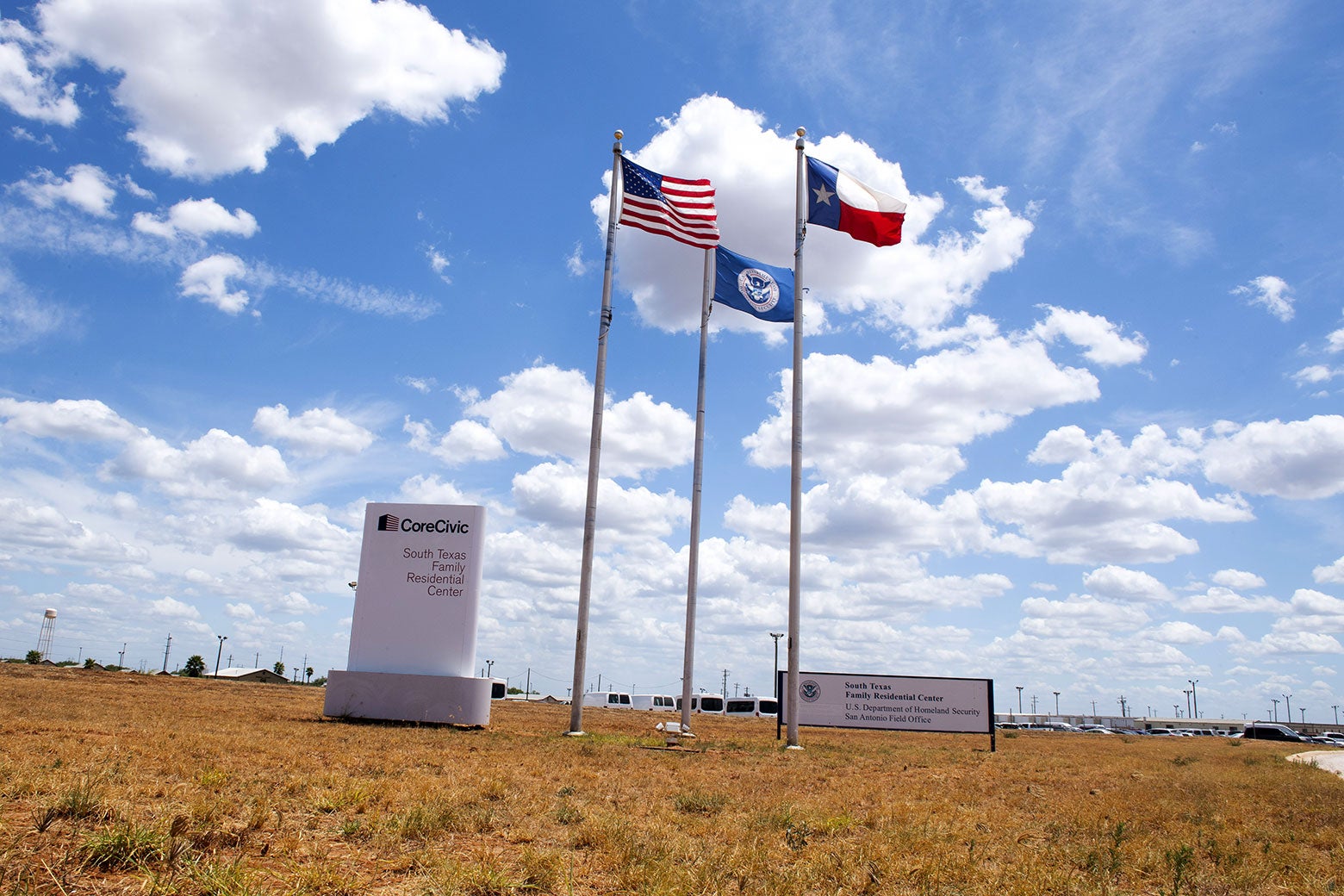
ICE officials held us at the courthouse all day with no food before transferring us to temporary housing for the night. At around 3 the next morning, officers woke us and put us on a commercial flight. Against our will, we were flown across the country to the family detention center in Dilley, Texas. The next two months we spent there were a living nightmare.
When my family and I had fled Colombia in October 2022, we believed that the United States would be a place of refuge. Back home, we had been targeted by an armed guerrilla group—the Revolutionary Armed Forces of Colombia—and over time, the death threats and physical violence became impossible to hide from. We had no choice but to flee for our lives.
On our way to the U.S., armed smugglers confined my daughter and me in a guarded safe house for days. I was forced to cook and clean for them, along with the other women. I was warned to watch my daughter closely so she would not be kidnapped. Only after being passed between multiple vehicles and handlers were we finally able to cross the border in November 2022.
After we arrived in the United States, we built a new life in Queens, New York. My daughter started school. She enjoyed art class and adored her teacher. She loved our cat. She was happy.
We applied for asylum. We were denied. But the dangers we faced in Colombia had not ended. From abroad, we learned that my husband was still receiving threats.
Because of my experience in Mexico, we then filed an application for a T visa, a form of humanitarian protection for victims of human trafficking. While that application was pending, we continued to comply with immigration authorities because we believed that following the law mattered.
That is why, even after being warned that attending our Sept. 15 check-in could lead to detention, we went anyway. But our compliance did not matter to ICE.
After we were taken to the Dilley detention center, my husband was held in a separate area from my daughter and me. Starting the first day, officers began using family separation as a threat. We were told that if we refused deportation, we would be fined $1,000 a day. We were warned that if we continued to resist deportation in any way, my husband and I could face criminal charges and our daughter could be taken from us. The officers also threatened to put us all on separate deportation flights.
The conditions at the facility only intensified the horror. People were constantly sick. Bathrooms were filthy. The food was often inedible, and the water was discolored. My daughter began losing weight because she could not eat.
Every Wednesday, deportation flights left for Colombia. Every Wednesday, we waited in fear for our names to be called. Officers unsuccessfully tried to deport us twice.
The constant threats took a toll on my health. I began experiencing regular panic attacks driven by the fear that my family would be separated or deported. I also suffer from chronic migraines, which worsened over time because the facility would not provide the medication I needed. I lived for weeks with steady pain, fainting spells, nosebleeds, and vision changes that made it difficult to function.
My daughter’s health deteriorated even faster.
At Dilley, she went from full-time school to just one hour of instruction a day. She contracted a cough, which only got worse. She cried at night and asked when we would go back to our apartment in New York. She asked about her teacher and our cat every day. My daughter was once an extroverted, healthy, and happy first grader. But at Dilley, she regressed behaviorally, wetting herself after years without accidents and begging to breastfeed again despite being 6 years old. When we sought mental health care, a psychiatrist blamed me for her distress and accused me of poor parenting.
Then my daughter’s eye was injured.
A facility staff member accidentally struck her eye with a mop. Blood came from her eye. At the medical center, the injury was falsely recorded as a fall. Despite my daughter’s continued complaints of blurred vision, light sensitivity, and hearing problems, doctors dismissed us.
After over a month of delays, an ophthalmologist who evaluated my daughter warned that she may have suffered trauma to her eye and needed further evaluation, as well as a referral to an ENT specialist because the injury could also be affecting her hearing. My husband and I repeatedly begged the facility to provide this care, but officers insisted that it was not their responsibility—even though the injury had been caused by a staff member.
In the days before our deportation, my husband and daughter began experiencing stomach illnesses. Both suffered from vomiting and diarrhea. My husband was placed in the medical unit. He was pale and visibly unwell. For a moment, I believed that because he was so sick, ICE would not deport us.
I was wrong.
On Wednesday, Nov. 12, ICE officers entered our room and ordered us to pack, saying we were leaving that day. My husband was taken out of the medical unit to be deported. My daughter was still coughing and vomiting. When I explained that they were too sick to travel, the agents accused me of inventing my husband’s illness, refused to let me call our lawyers, and denied my request to see a doctor. Despite my daughter’s untreated eye injury and serious cough, the officers insisted she was fine and said her health was not their responsibility.
Nearly 10 ICE agents with chains and handcuffs surrounded us and cautioned that we could leave “the easy way or the hard way.” My daughter was terrified. When she saw the chains, she screamed and cried. Officers again refused to let us contact our lawyers. There was no real choice but to comply.
They put us on a bus, along with one other woman, to transport us to Louisiana for our deportation flight. About an hour into the drive, the bus stopped, and dozens of men in chains and handcuffs got on, along with another handcuffed woman, who looked at my child and asked aloud how anyone could allow a little girl to witness this. My daughter began to cry again.
The bus ride to Louisiana was over 18 hours. We were not able to use the bathroom the entire time. At 9 a.m., while we were still on the bus, I fainted and hit my head. After I begged for medical help, the paramedic who evaluated me suggested I go to a medical center. But ICE officers refused, telling me I had no right to see a doctor.
My daughter also began to vomit on the bus that morning. For hours, despite our requests, the officers refused to give her food or water.
She received no food or water until later that afternoon, on our flight back to Colombia. I had pleaded with the officers not to put us on the plane, explaining that the pressure would worsen our health conditions, but they did not care.
My daughter vomited the entire flight. When we landed in Bogotá, she was still vomiting and coughing and was severely dehydrated. She wanted to know why we were not in New York, but I had no answers—only fear.
Today we live in hiding in Colombia. Armed groups still control our region. We cannot safely access medical care.
My daughter continues to suffer from serious vision and hearing problems but has not been able to see a specialist. Her stomach issues also have not improved, and a doctor in Colombia has diagnosed her with a severe bacterial infection. I continue to suffer from chronic migraines and anxiety, without medication. My husband and I are terrified every day that we will be murdered and our daughter will be kidnapped by the Revolutionary Armed Forces of Colombia.
My daughter is only 6 years old. She should not know chains or handcuffs or the terror of her family being torn apart. She should never have been swept off the streets of New York or locked in a detention facility for two months. She should be in school in the United States, playing with her friends and receiving the medical care she needs.
Instead, ICE treated us like animals. Officers intimidated, restrained, and deported us without regard for our humanity. Our basic rights were violated, with no accountability or justice. My daughter is traumatized and cries every day.
We don’t know what our future will hold. But we are grateful for the time we had in America, and we will keep fighting for a better future for our daughter.