Why Americans Suddenly Stopped Hanging Out
Too much aloneness is creating a crisis of social fitness.

This is Work in Progress, a newsletter about work, technology, and how to solve some of America’s biggest problems. Sign up here.
In its earliest decades, the United States was celebrated for its citizens’ extroversion. Americans weren’t just setting out to build new churches and new cities. Their associations were, as Alexis de Tocqueville wrote, “of a thousand different types … religious, moral, serious, futile, very general and very limited, immensely large and very minute.” Americans seemed adept at forming social groups: political associations, labor unions, local memberships. It was as if the continent itself had imbued its residents with a vibrant social metabolism—a verve for getting out and hanging out. “Nothing, in my view,” de Tocqueville wrote, “deserves more attention than the intellectual and moral associations in America.”
Something’s changed in the past few decades. After the 1970s, American dynamism declined. Americans moved less from place to place. They stopped showing up at their churches and temples. In the 1990s, the sociologist Robert Putnam recognized that America’s social metabolism was slowing down. In the book Bowling Alone, he gathered reams of statistical evidence to prove that America’s penchant for starting and joining associations appeared to be in free fall. Book clubs and bowling leagues were going bust.
If Putnam felt the first raindrops of an antisocial revolution in America, the downpour is fully here, and we’re all getting washed away in the flood. From 2003 to 2022, American men reduced their average hours of face-to-face socializing by about 30 percent. For unmarried Americans, the decline was even bigger—more than 35 percent. For teenagers, it was more than 45 percent. Boys and girls ages 15 to 19 reduced their weekly social hangouts by more than three hours a week. In short, there is no statistical record of any other period in U.S. history when people have spent more time on their own.
And so what? one might reasonably ask. Aloneness is not loneliness. Not only that, one might point out, the texture of aloneness has changed. Solitude is less solitary than ever. With all the calling, texting, emailing, work chatting, DMing, and posting, we are producing unprecedented terabytes of interpersonal communication. If Americans were happy—about themselves, about their friends, about their country—then whining about parties of one would feel silly.
But for Americans in the 2020s, solitude, anxiety, and dissatisfaction seem to be rising in lockstep. Surveys show that Americans, and especially young Americans, have never been more anxious about their own lives or more depressed about the future of the country. Teenage depression and hopelessness are setting new annual records every year. The share of young people who say they have a close friend has plummeted. Americans have been so depressed about the state of the nation for so many consecutive years that by 2023, NBC pollsters said, “We have never before seen this level of sustained pessimism in the 30-year-plus history of the poll.”
I don’t think hanging out more will solve every problem. But I do think every social crisis in the U.S. could be helped somewhat if people spent a little more time with other people and a little less time gazing into digital content that’s designed to make us anxious and despondent about the world. This young century, Americans have collectively submitted to a national experiment to deprive ourselves of camaraderie in the world of flesh and steel, choosing instead to grow (and grow and grow) the time we spend by ourselves, gazing into screens, wherein actors and influencers often engage in the very acts of physical proximity that we deny ourselves. It’s been a weird experiment. And the results haven’t been pretty.
To get a crystal-clear picture of how hanging out has dissipated in America, I spent the past week spelunking inside the American Time Use Survey, an annual government poll of how people in the U.S. spend their days. Economists at ATUS carefully track time spent socializing—meaning face-to-face interaction—for more than a dozen demographics.
Broadly, real-world socializing has declined for both men and women, for all ages, for all ethnicities, and for all levels of income and education. Although COVID-19 clearly increased time alone, these trends predate the pandemic. The steepest declines have been among young people, poor people, and Black Americans. Women and 20-somethings enjoy the most social time in a given week, and low-income, middle-aged, unmarried men seem to get together the least. For most groups, the decline was staggered before accelerating after 2015. Beyond in-person hanging, several other forms of socialization have declined by about a third in the past 20 years, including the share of Americans who volunteer and the share of Americans who attend religious services over the weekend.
One of the more curious trends to jump out of the data is that many Americans have traded people for pets in our social time. The average time that Americans spend with their pets has roughly doubled in the past 20 years—both because more people have adopted pets and because they spend more time with them. In 2003, the typical female pet owner spent much more time socializing with humans than playing with her cat or dog. By 2022, this flipped, and the average woman with a pet now spends more time “actively engaged” with her pet than she spends hanging out face-to-face with fellow humans on any given day.
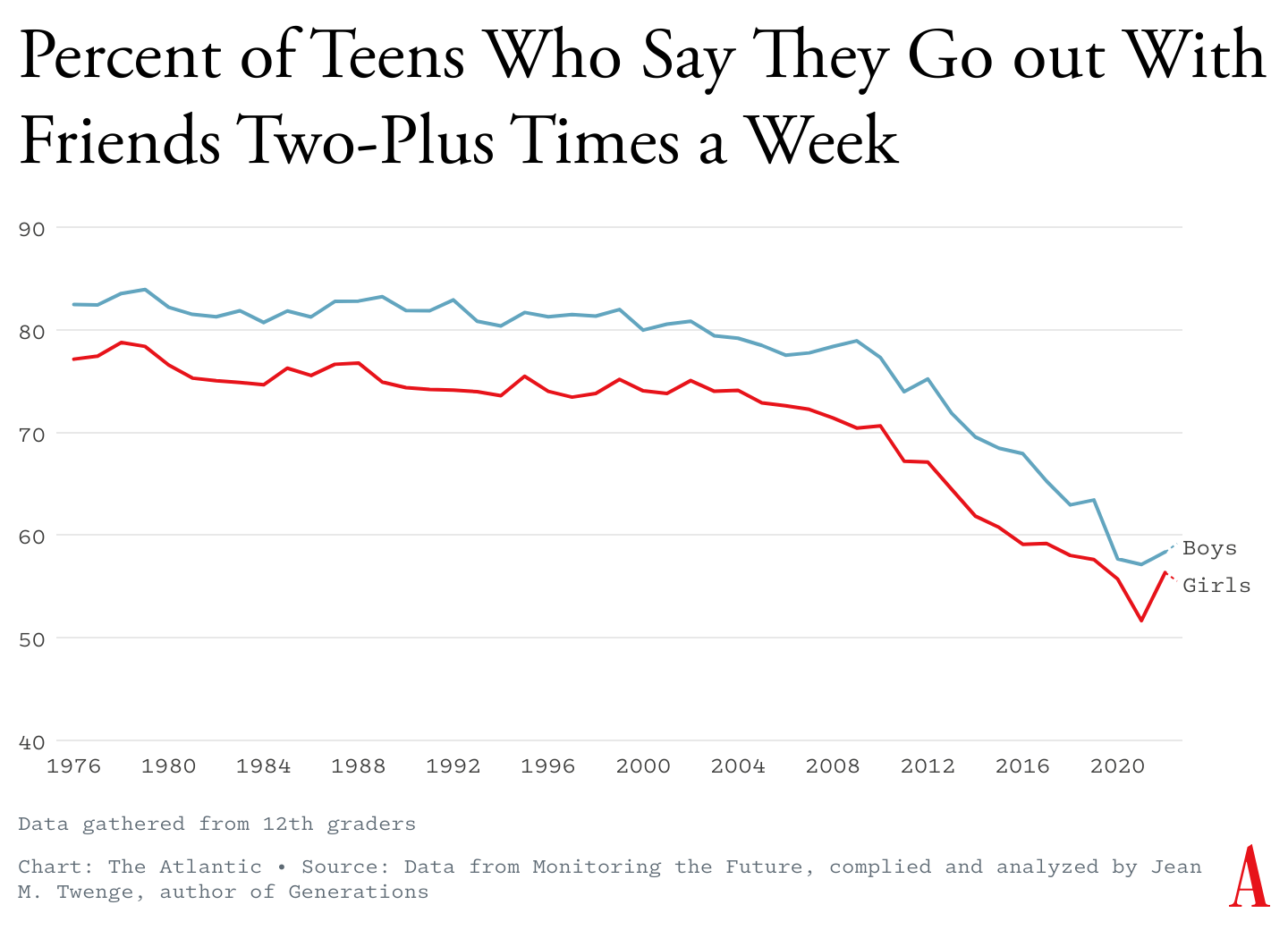
The hang-out depression is particularly bad for teenagers. According to the ATUS, teens and young adults saw by far the largest dip in socializing, especially since 2010. In fact, it is genuinely difficult to find any category of play that isn’t experiencing some kind of Mayday! Mayday! descent among this group. Teens are dating less, playing fewer youth sports, spending less time with their friends, and making fewer friends to begin with. In the late 1970s, more than half of 12th graders got together with their buddies almost every day. By 2017, only 28 percent did. “There’s very clearly been a striking decline in in-person socializing among teens and young adults, whether it’s going to parties, driving around in cars, going to the mall, or just about anything that has to do with getting together in person,” says Jean Twenge, a psychology professor at San Diego State University.
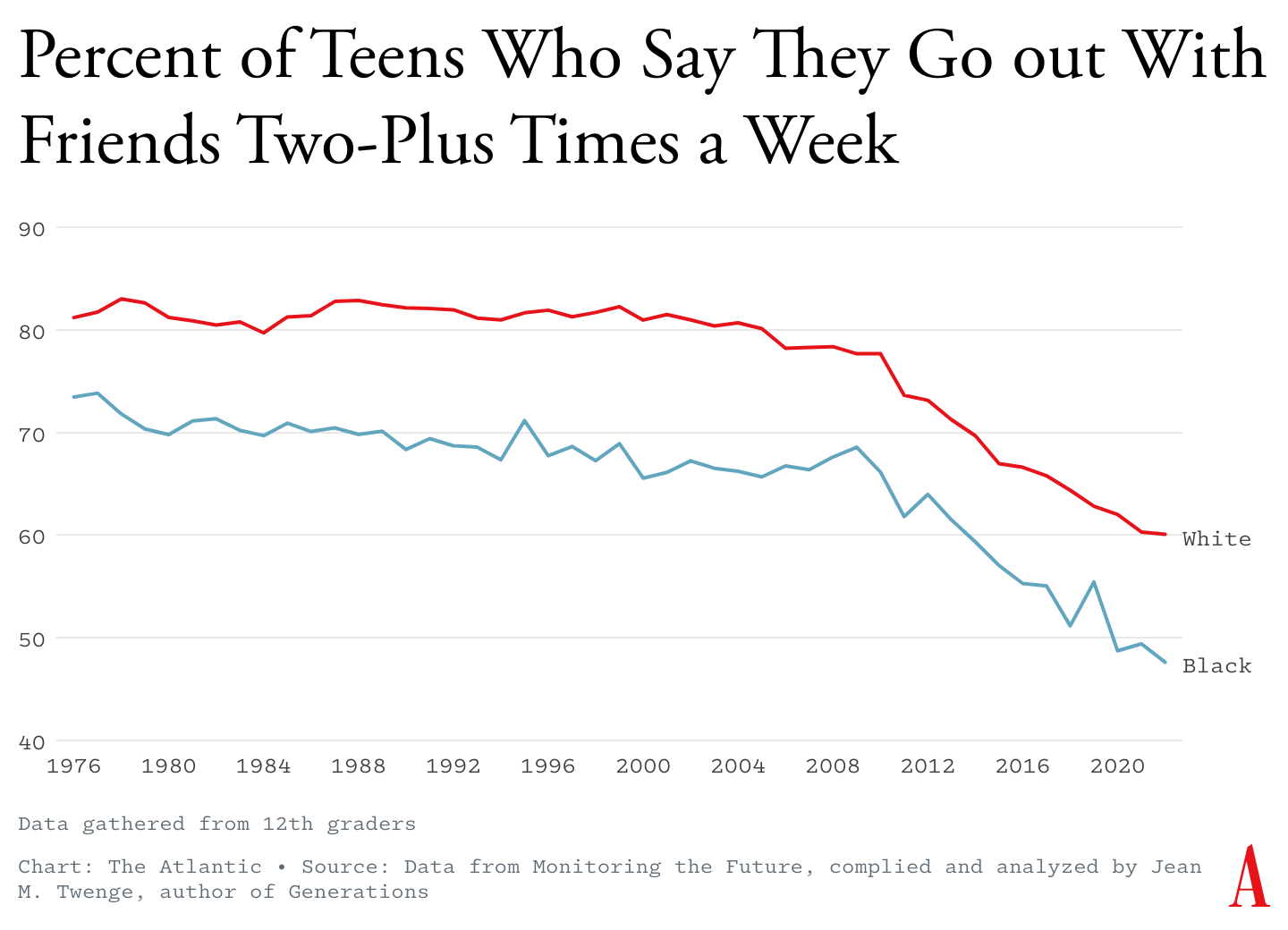
I asked Twenge if she could identify large differences by gender or ethnicity among teenagers. She pulled data from the University of Michigan’s Monitoring the Future, a decades-old survey of teens, which we’ve used to make the following charts. The first shows the share of 12th-grade boys and girls who say they go out with friends two or more times a week. From 1976 to 2022, the number of socializers fell by a similar figure—about 30 percent. Hangouts declined a bit more among Black teens than white teens.
What are the root causes of the great American introversion?
The first explanation is so obvious that it scarcely needs mentioning; in fact, I’ve already mentioned it. Americans are spending less time with other people because they’re spending more time with their screens—televisions and phones. The evidence that young people have replaced friend time with phone time is strong. As Twenge wrote in her book Generations, it’s not just that teens overall seem to have funneled their social lives into their smartphones. Even more telling, the groups with the largest increase in phone use, such as liberal 12th-grade girls, also saw the largest declines in hanging out with friends, strongly suggesting a direct relationship. For those who don’t accept that correlative evidence, we also have a 2019 randomized experiment from NYU and Stanford researchers who found that paying people to deactivate Facebook increased the time they spent socializing with friends. (It also increased the time they watch TV.)
The second explanation is that people are hanging out less because we’re all so damn busy. As The New York Times’ Jessica Grose notes, people in their 30s and 40s have less leisure time than they did two decades ago. As Anne Helen Petersen has said, Americans have a tendency to spread out, and the built environment of the U.S. housing market forces many people to move away from friends and family, which means they ultimately buy a bit of loneliness with their money.
It’s a compelling argument, and as a new father, I can appreciate how the demands of child care and work might squeeze out the last drops of social time. But the data say this can’t be the whole story. Research by the Philadelphia Fed has found that time alone has increased most for low-income, nonwhite individuals, for whom hours worked haven’t increased much in the past 20 years. This would complicate the idea that loneliness is the price of overscheduled busyness. Twenge told me she’s also unconvinced by the argument about congested schedules, at least as it applies to teenagers. “Sometimes I’ll hear the case that teens are spending so much more time on homework, but the evidence suggests it’s just not true,” she said. “In fact, homework time has gone down in the past few years. The share of teens who have jobs has gone down. Despite some parents jam-packing their kids’ schedules, overall extracurricular time looks pretty stable in surveys. If anything, teens today have more leisure time than they used to. They just choose to spend it on their phones.”
A third explanation for America’s cascading social mojo is the Putnam theory described in Bowling Alone: The rise of aloneness is a part of the erosion of America’s social infrastructure. Someone once told me that the best definition of community is “where people keep showing up.” Well, where is that now, exactly? Certainly not church; each successive generation is attending less than their parents’. Not community centers, or youth sports fields. Even the dubious community-building power of the office, arguably the last community standing for many, is weakening with the popularity of hybrid and remote work. America is suffering a kind of ritual recession, with fewer community-based routines and more entertainment for, and empowerment of, individuals and the aloneness that they choose.
When you put these three stories together, you get something like this: Face-to-face rituals and customs are pulling on our time less, and face-to-screen technologies are pulling on our attention more. The inevitable result is a hang-out depression.
And for young people, all this seems to clearly correlate with actual depression. Teen loneliness has surged in the past decade, alongside teen hopelessness, depression, and suicidal thinking. According to the CDC’s Youth Risk Behavior Surveillance System, the share of teenage girls who say they experience “persistent feelings of sadness or hopelessness” increased from 36 to 57 percent, and the share of girls who said they’ve contemplated suicide increased 50 percent in the same decade. Neither the decline in socializing nor the surge in mental distress has any precedent on record.
The rise in teen depression coincides with the proliferation of smartphones and social media. “It’s very suspicious that teen anxiety and depression really started to take off around 2012, because that’s when 50 percent of Americans owned a smartphone, when social media went from optional to virtually mandatory, and when smartphones got front-facing cameras,” Twenge told me. Academics including Twenge and the social psychologist Jonathan Haidt have repeatedly argued that phones have driven an anxiety crisis among America’s youth, in part by reducing the presence of physical-world relationships that are necessary for healthy adolescent development. Swapping touches for screen taps, America’s kids are experiencing a more solitary, and melancholy, childhood than we’ve ever seen.
During my time picking through ATUS data, I was reminded of the Harvard Study of Adult Development, which is the oldest longitudinal study on happiness and well-being ever conducted. Last year, its directors said that the “simple and profound conclusion” of their work was that good relationships are the key to happiness. Just as many people are familiar with the concept of physical fitness, they said, we should be equally open to the concept of social fitness. We should care for our relationships as we’d care for our body.
Public-health experts are comfortable talking about the way several modern phenomena—such as caloric density and a built environment that discourages walking—have contributed to the surge in obesity. One interpretation of the rise in diet-related diseases is that humans are “dysevolved” for a modern food system so rich with carbs, sugars, and manufactured tastiness. Engineered to confront caloric scarcity, we’ve come up in a world of caloric abundance. The result of this mismatch is an obesity crisis and other calamities in physical fitness.
One can imagine a similar framework to explain the deterioration of America’s social fitness. We come into this world craving the presence of others. But a few modern trends—a sprawling built environment, the decline of church, social mobility that moves people away from friends and family—spread us out as adults in a way that invites disconnection. Meanwhile, as an evolutionary hangover from a more dangerous world, we are exquisitely engineered to pay attention to spectacle and catastrophe. But screens have replaced a chunk of our physical-world experience with a digital simulacrum that has enough spectacle and catastrophe to capture hours of our greedy attention. These devices so absorb us that it’s very difficult to engage with them and be present with other people.
The sum result of these trends is that we are both pushed and pulled toward a level of aloneness for which we are dysevolved and emotionally unprepared. Sartre said hell is other people. Perhaps. But the alternative is worse.